

The Photographers of Gaza: “Keepers of Memory” — A Journey Born from a Friend’s Blood
 佐藤慧
佐藤慧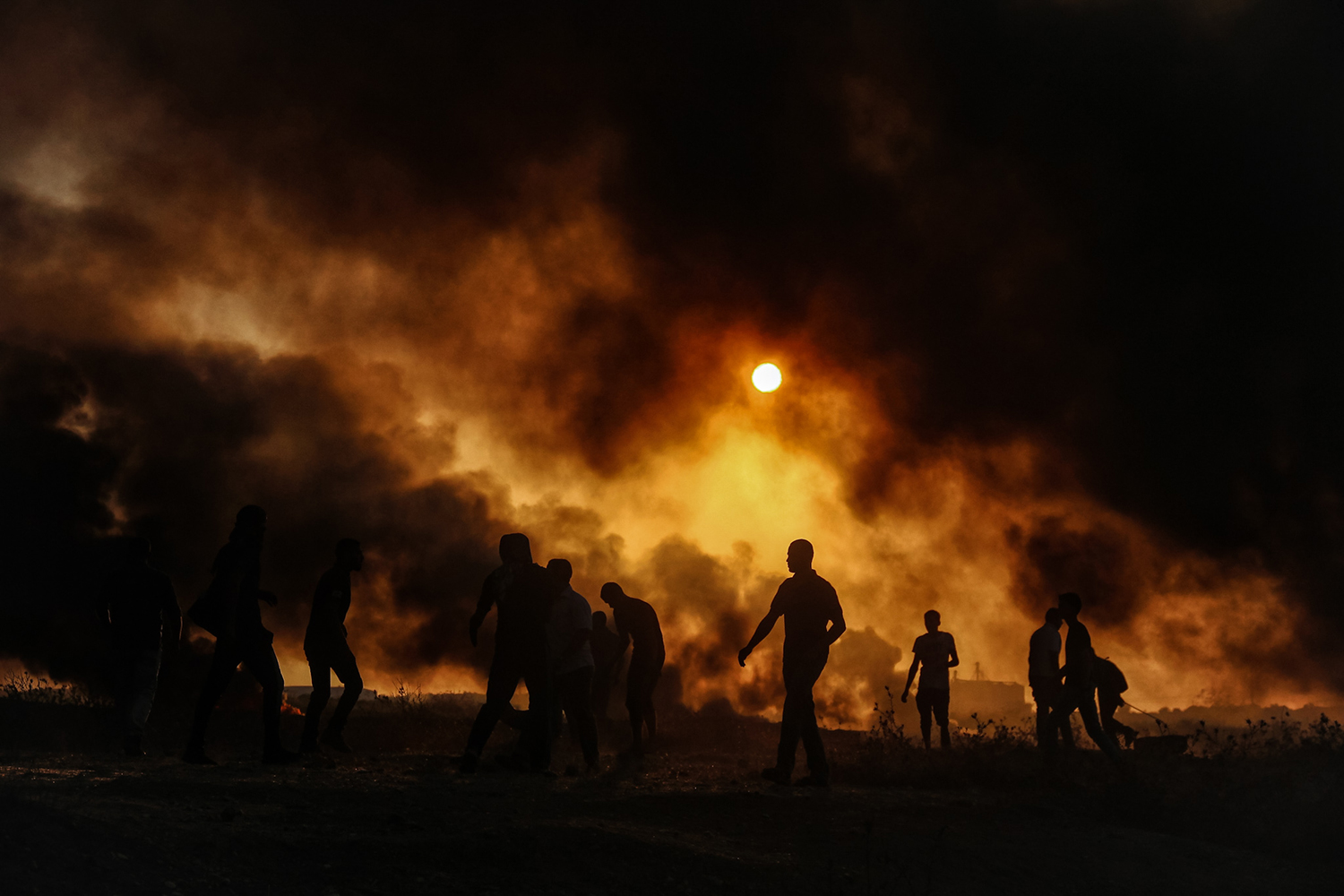
Even after the “ceasefire,” the killing in Gaza continues. This is the contributed article written by Mohammed H Salem, a photographer from Gaza and D4P field reporting partner.
Mohammed H Salem
A photographer from Gaza. He collaborates with various photo agencies, and he is a co-founder of the platform “Untold Palestine”. His work has been featured in a wide range of international and local magazines and media. He also works with Al Jazeera English as a freelance photographer.
My path to photography was not covered with a welcoming red carpet or with academic accolades. Rather, it was with the remains of and devotion to blood that had not gone cold yet.
In Gaza, we often do not choose our careers. They choose us as we find ourselves facing the responsibility of documenting the truth that many attempt to suppress.
Contents 目次
A Journey Born from a Friend’s Blood
My story started in 2018, specifically with the beginning of “the March of Return” near the borders of the Gaza Strip.
At that time, I did not have any professional gear; I was carrying a Canon 600D camera with a modest mm55-18 lens. Any photographer would consider this equipment to be nothing in a war zone or an area under attack. Yet, behind that small lens, there was something motivating me more than the quality of the photo:
the blood of my friend.
My friend Ahmad Abu Hussein was martyred while he was holding a camera to document what was happening. From that moment onward, I felt that photography is not just a “hobby.”
Photography is a higher purpose and responsibility.
I told myself: “If he died for the sake of delivering this photo, then we cannot take this mission lightly.”
I went to the border on the first day of coverage, and while the bullets were being fired around me, it was my people cheering me on when they saw my photos that motivated me to continue.
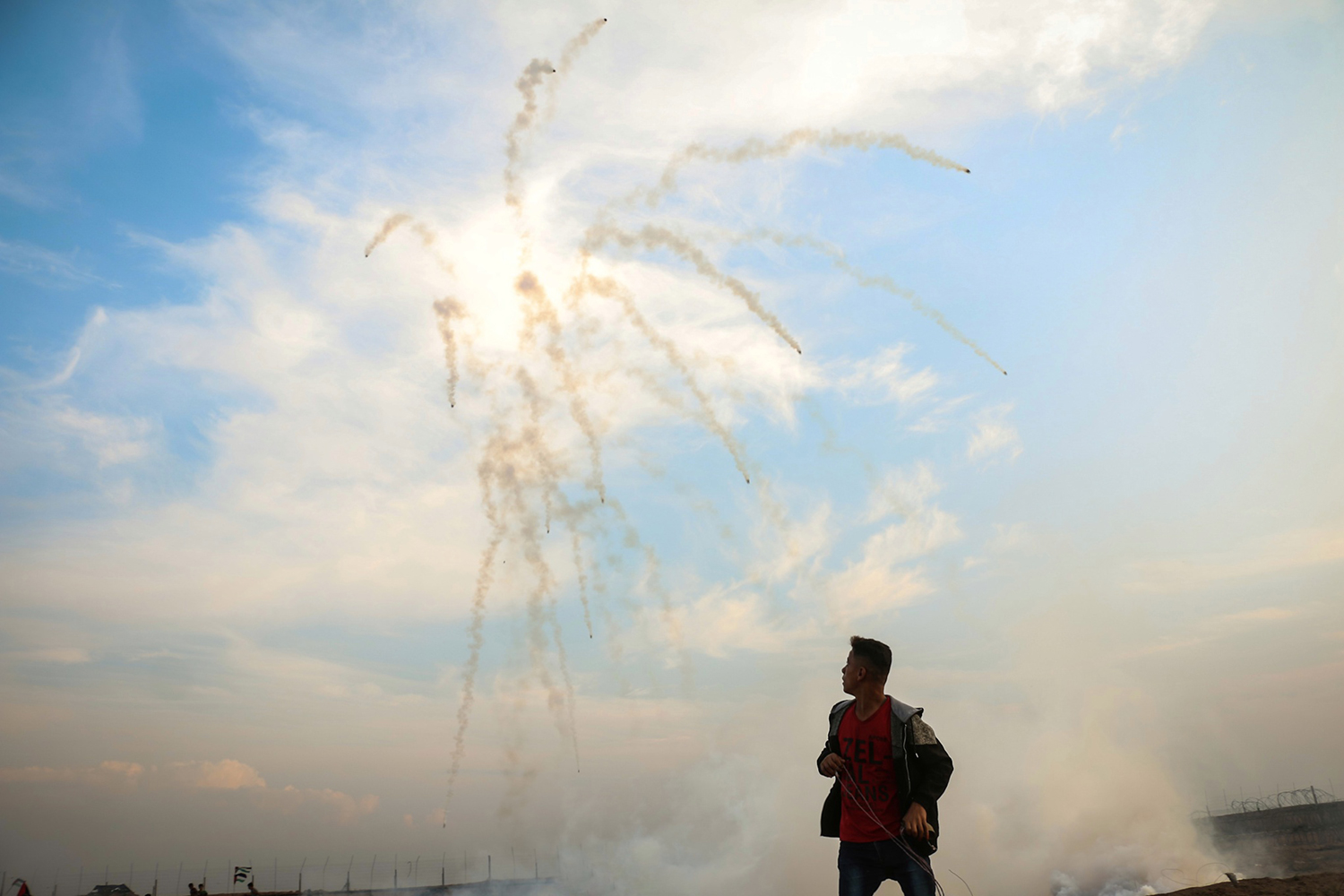
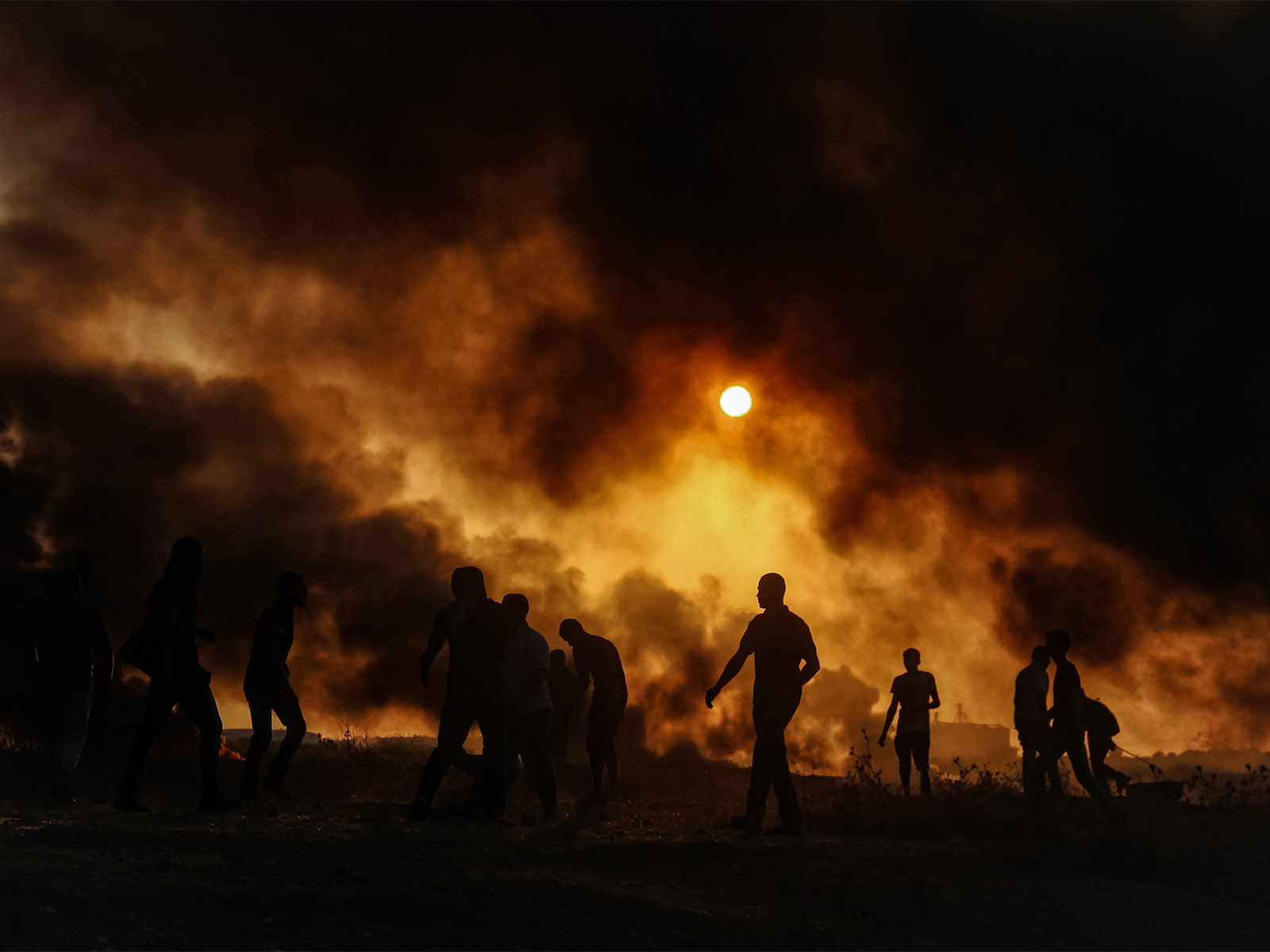
A young Palestinian man attempts to escape tear gas canisters fired by Israeli forces near the eastern border of the Jabalia refugee camp, northern Gaza Strip, during the “Great March of Return.” (Photo by Mohammed H. Salem / 2018)
Focusing the Lens on Daily Life: More Than Just Numbers
In the beginning, I used to take photos out of love and loyalty. But, soon after, I became aware that the only images the world sees from Gaza are in breaking news. Since that moment, daily life in Gaza became the guiding compass for my work. I wanted to prove to the world that we are not just numbers on news programs; we are people who love, farm the land, play, and dream.
This is when I felt at odds with my own feelings. While many people ask me: “How can you separate your feelings as a Gazan between your relationship to the city and your work as a photographer?”
The fact of the matter is that these two are inseparable.
I remember the first funeral that I went to cover. I was not able to capture one photo. I sobbed my heart out and went back home. With time, however, I learned that my tears will not help my people as much as my photography could.
Taking photos in Gaza is a constant attempt at finding beauty in the ugliness that the incessant wars have forced on us. When I take photos of a young man doing parkour on top of ruins, or a child making an airplane out of repurposed plastic, I am not just documenting poverty, I am documenting how humanity can transcend pain.
In 2019, I transitioned from taking photos as a hobby to becoming a professional as I began working for various media companies or organizations. The first international news organization I worked for was Middle East Eye.
After that I worked with Untold Palestine, the platform that I co-founded to tell the stories and memories of people who were martyred, or people who live proudly behind stubborn unbreakable wars. In the middle of the year 2021, I began working independently with Aljazeera English.
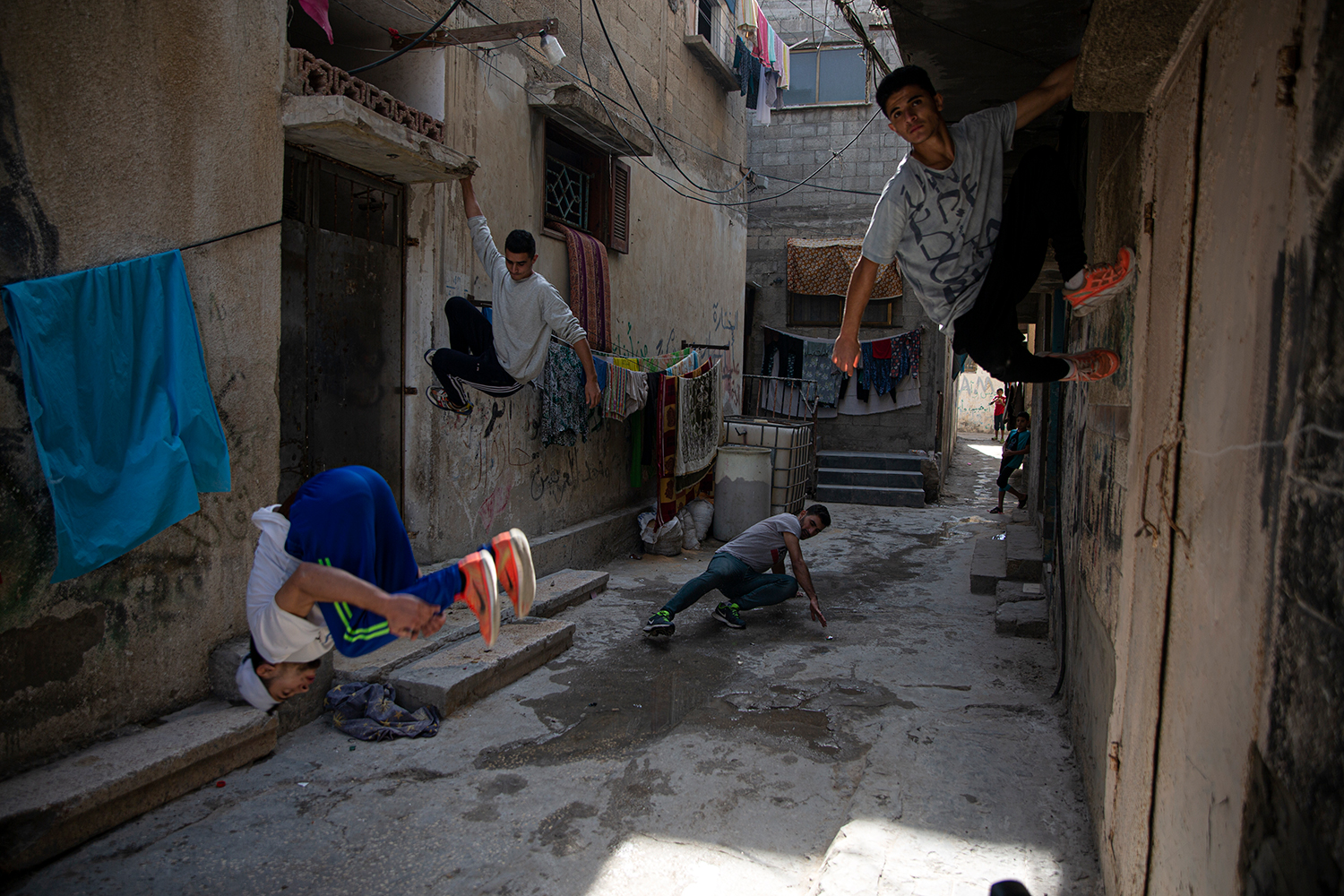
Palestinian youths practice parkour in an alleyway of the Al-Shati refugee camp, western Gaza City. (Photo by Mohammed H. Salem / 2021)
The Loss of Over 300 Relatives and Friends
I left Gaza on Wednesday, October 4th, 2023, three days before the genocidal war began. I was planning a tourism trip for three weeks around Egypt then Saudi Arabia, where I was hoping to find a job opportunity by November.
It was an uncomfortable trip since we have to go by car from Gaza until we reach Cairo. On Saturday, I woke up to the news that a war has erupted.
This was a pivotal moment in my life. I canceled my trip to Saudi Arabia, hoping the war would end soon so that I could return home.
My family’s home was bombed very early in the war, on October 8, 2023, because we live in Al-Sudaniya neighborhood, which is close to the border. It is west of Beit Lahia city in the north of the Gaza Strip.
I stopped leaving the house I was staying at in Egypt. I became glued to the television screen on one side, and gripping my phone in my hand on the other, so that I can stay up-to-date with the news from every direction.
The first shocking loss for our family was when we lost my cousin Wissam on October 10, 2023, and since then many more shocking losses came upon us.
The Israeli army enacted two massacres upon my family. The first massacre was on December 12, 2023, when they bombed Sheikh Radwan neighborhood. We lost around 100 family members that day.
The second massacre happened on December 19, 2023, when we lost around 160 martyrs. By the time of the January 2025 ceasefire, the number of martyrs in my family was close to 300. We lost cousins, aunts, uncles, and their children and grandchildren, and many of our relatives.
On a personal level, I also lost many friends and acquaintances with whom I had started my journey in photography and who supported me quite a lot.
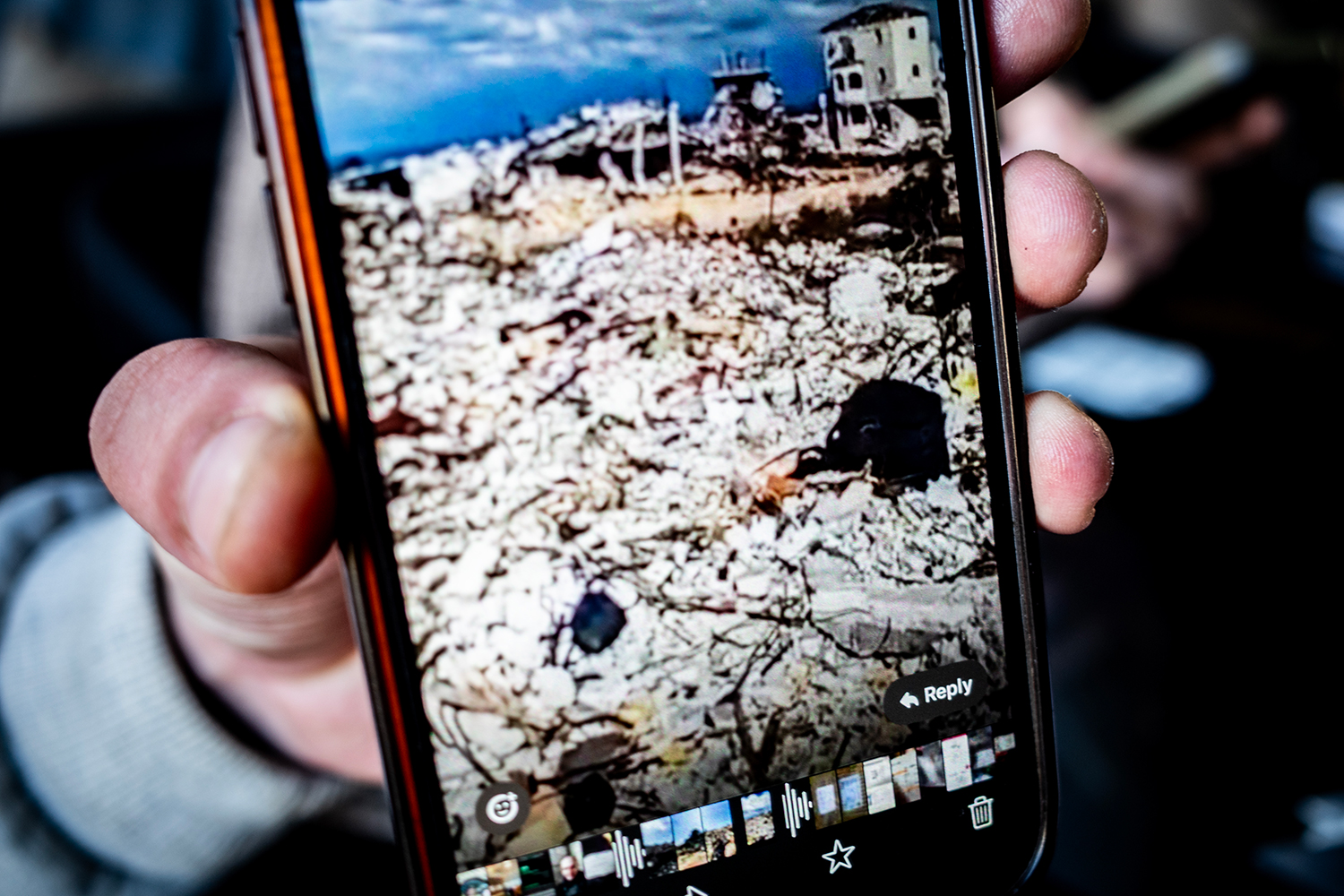
In Cairo, Mohammed shows a photograph of his hometown, now reduced to rubble. Many displaced people have experienced traumatic losses and bereavements. (Photo by Kei Sato / 2025)
Documenting the Stories of Those Living in the Now
As a result of all this, I could not go search for work abroad.
Before the massacres took place, I held two exhibitions of my work. The first was called “For Gaza,” and it took place on December 8, 2023. I was so depressed after this exhibition that I could not leave the house. For about five months, I sat there doing nothing.
After that, I held my second exhibition “Gaza, My Darling” in collaboration with the French Institute in Alexandria on May 9th, 2024. After that exhibition, I felt like I could no longer deal with people, and was in a state where it was too difficult for me to work.
When the first ceasefire started on January 19, 2025, my family were the first to encourage me to stay abroad and think about my life, especially since they thought that the war is over, and that I must do something with my life.
I worked with many global organizations that work with Palestinians from Gaza who are in Cairo. This was the catalyst for another exhibition idea, which I called “Gaza, Cairo, and Hope.”
This was a documentary photography project, where I used my lens as a visual narrator to tell deep human stories about individuals and families who had to leave Gaza during the war, and who have settled recently in Cairo.
I recorded the stories of people who lost their loved ones, and who live today with a silent pain, trying to keep the memory alive in the midst of a merciless reality. I saw on their faces the features of resilience, an insistence on life despite the heaviness that they carry.
In this project, I also held an exhibition in the French Institute in Alexandria. After that, I continued working with global organizations, while also designing and running workshops for Gazan adolescents to train them in photography. I also was a keynote speaker for “Cairo’s Photography Week,” which is the most important photography event in Egypt.
After repeated statements from the Occupation about Rafah Crossing, I felt depleted and frustrated. I started thinking that maybe I should make my way to Turkey. But, in order to get a visa to go to Turkey, I need to have a residency somewhere.
In January, 2026, I traveled to Malaysia. However, I quickly learned that I could not get a resident status there, because I only received a one-month visa. This prompted me to go to Libya, where I felt it could be more likely for me to get residency. This is where I am right now, in Benghazi, writing these words while I wait to see if I will receive residency status so that I can then apply for a visa for Turkey.
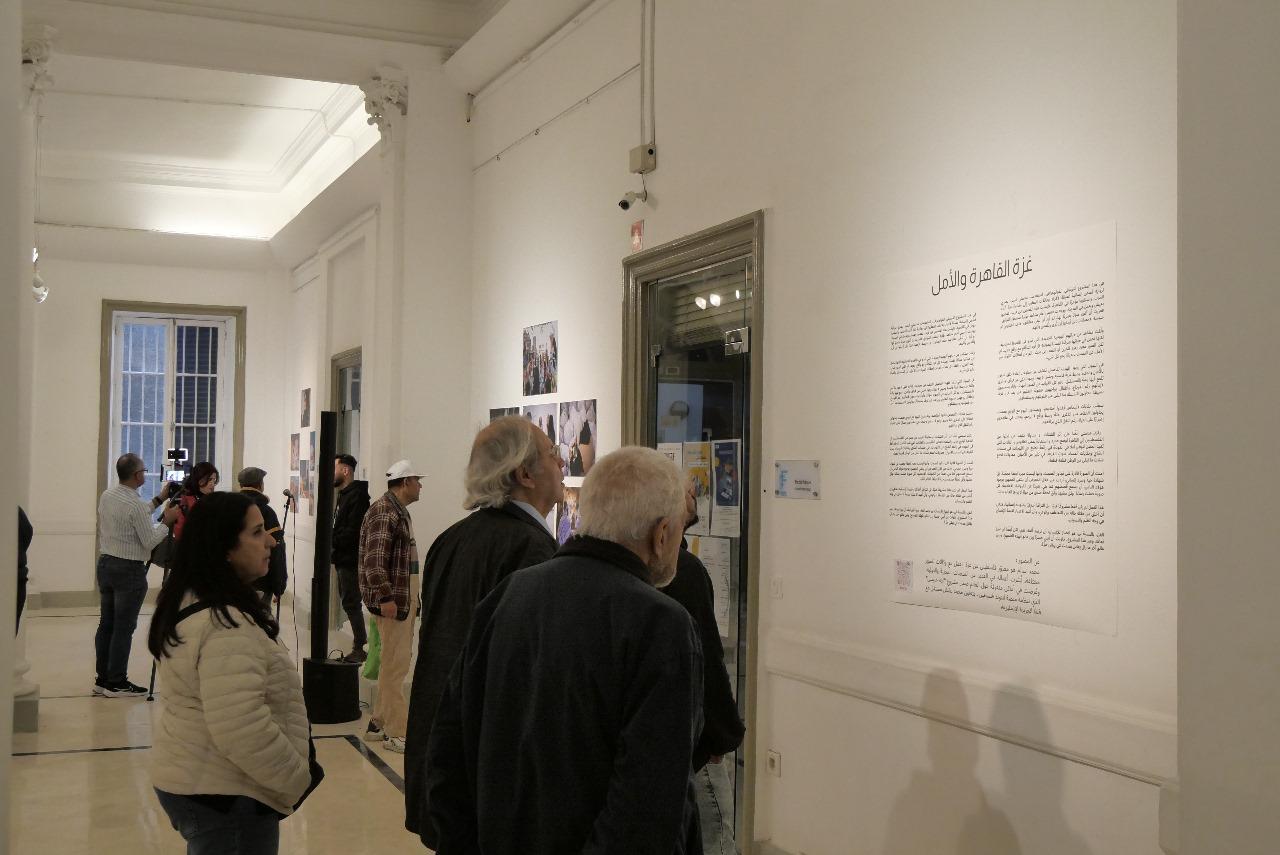
Visitors attend my exhibition “Gaza, Cairo and Hope” at the Institut français d’Alexandrie in Alexandria, Egypt.(Photo by Mohammed H. Salem / 2025)
A Gaza Photographer is a “Keeper of Memory”
In this last war, I lost a lot; I lost my home, I lost a huge part of my archive, and most painfully, I lost hundreds of my family and friends. But, today, when I look at my surviving photos, I see clearly that a Gazan photographer is a memory keeper.
I had started with a simple camera, and a lost friend. Today, I carry my lens to tell the world: try as you may to erase the features of our city, our photos will remain as witnesses attesting that we have been here, and here we will stay.
Ultimately, I believe that photography can overcome silence, and that it is not just a frozen moment, but rather a living witness and a human story.
I hope that, through my photos, viewers could receive the stories of people and hear their authentic voices, far from the noise of news media. Every photo carries with it a message, and every scene documents a moment of life that otherwise the world would not get to see.
I always say that, to me, art is an alignment with humanity.
It can capture a person’s pain and suffering, but it is also our duty to capture a person’s survival. Through my photos, I try to build a bridge between a world that has been devastated by the noise and a different world that still fights in silence to stay alive.
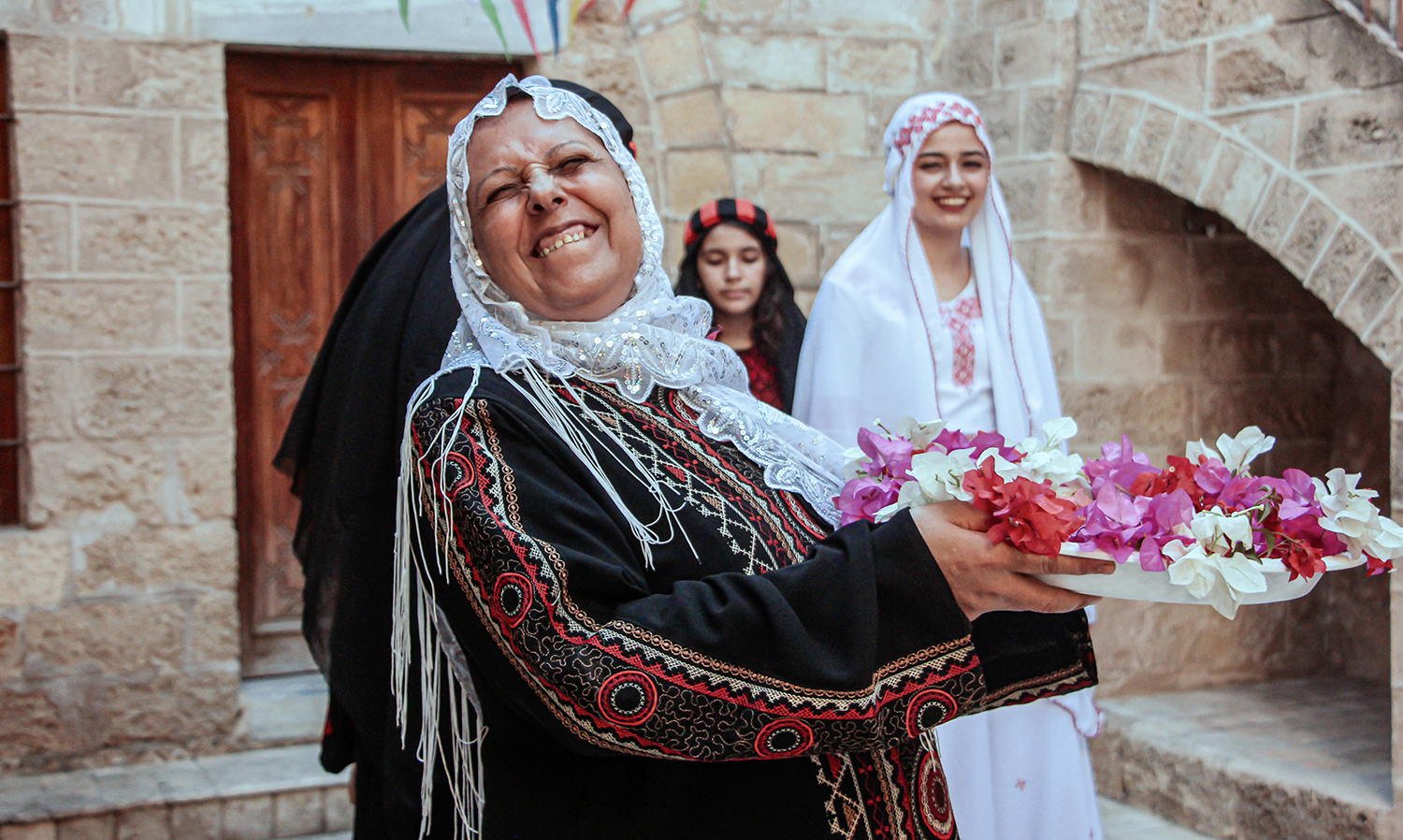
A woman expresses her joy during a traditional Palestinian wedding in Gaza City, her hands adorned with henna, a customary bridal practice. (Photo by Mohammed H. Salem / 2019)
(Text: Mohammed H. Salem/ Edit: Kei Sato)
あわせて読みたい・聴きたい
本記事の取材・執筆や、本サイトに掲載している国内外の取材、記事や動画の発信などの活動は、みなさまからのご寄付に支えられています。
これからも、世界の「無関心」を「関心」に変えるために、Dialogue for Peopleの活動をご支援ください。
寄付で支えるメールマガジンに登録しませんか?
新着コンテンツやイベント情報、メルマガ限定の取材ルポなどをお届けしています。
 安田菜津紀
安田菜津紀 D4P取材班