

From the Olive Tree to the Table―A Season of Life, Memory and Work in Gaza(Part 1)
Israel’s occupation in violation of international law and the massacres continue. Even before the establishment of the State of Israel on May 14, 1948, many Palestinians were displaced from their homeland. This is a contributed article written by Mohammed H Salem, a photographer from Gaza and D4P field reporting partner.
Mohammed H Salem
A photographer from Gaza. He collaborates with various photo agencies, and he is a co-founder of the platform “Untold Palestine”. His work has been featured in a wide range of international and local magazines and media. He also works with Al Jazeera English as a freelance photographer.
Contents 目次
A Season of Family
In Gaza, the olive season begins long before the fruit reaches the press.
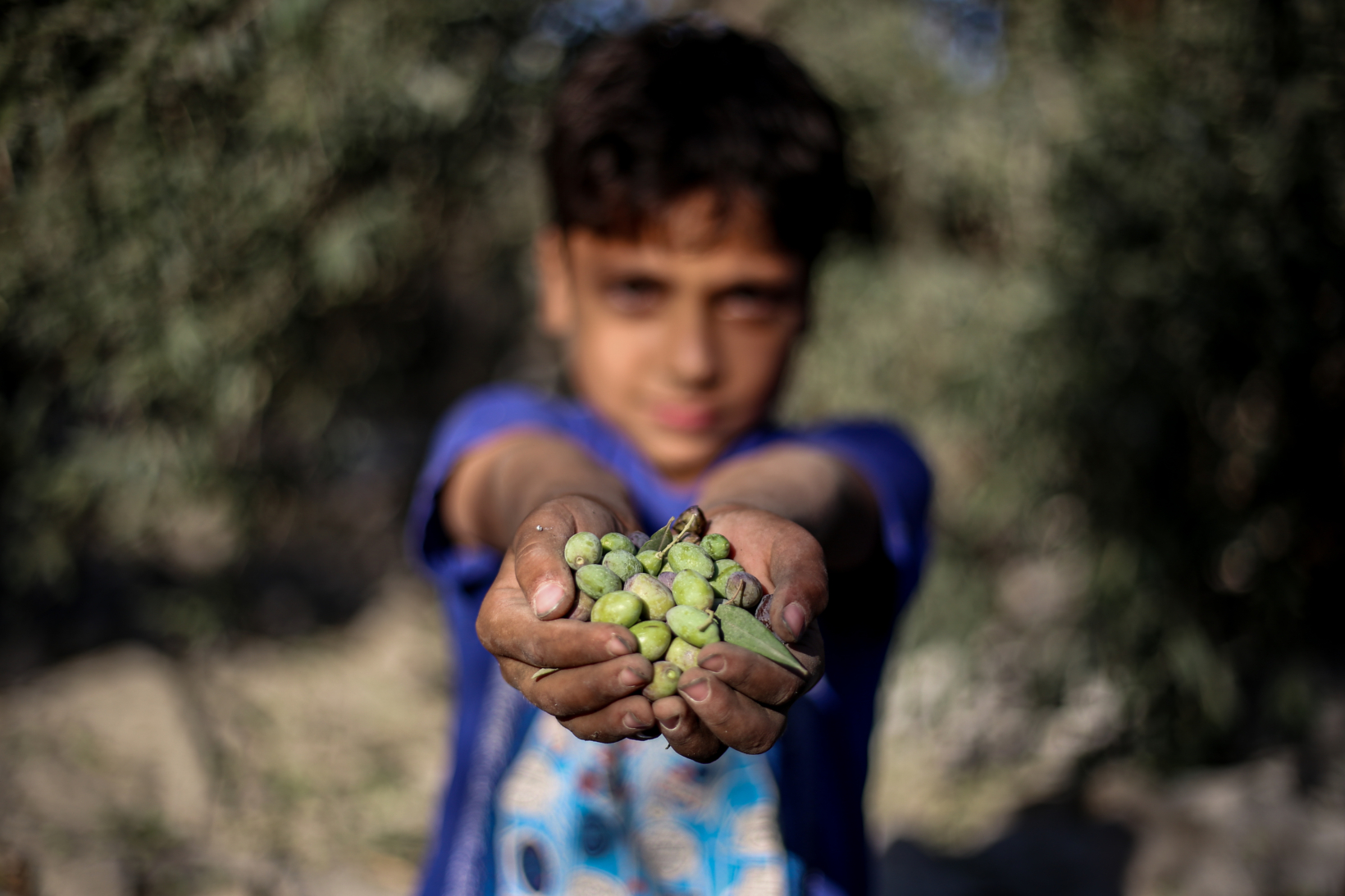
It begins in the soil, among trees that need a full year of care before the time comes to harvest their fruit. When autumn arrives, the fields become gathering places for families. Men, women, and children go out together, carrying baskets, sacks, sheets, and ladders, moving from one tree to the next.
In those moments, farming does not feel like an activity separate from everyday life. It unites the whole family in a single process.
One person climbs the tree, another gathers the fruits that fall, another sorts them, while others carry them to the crates. Children, too, have their place in the work, whether collecting olives, carrying them, or helping the older members of the family.
This is how the olive’s long journey begins: from the tree, into the human hand.
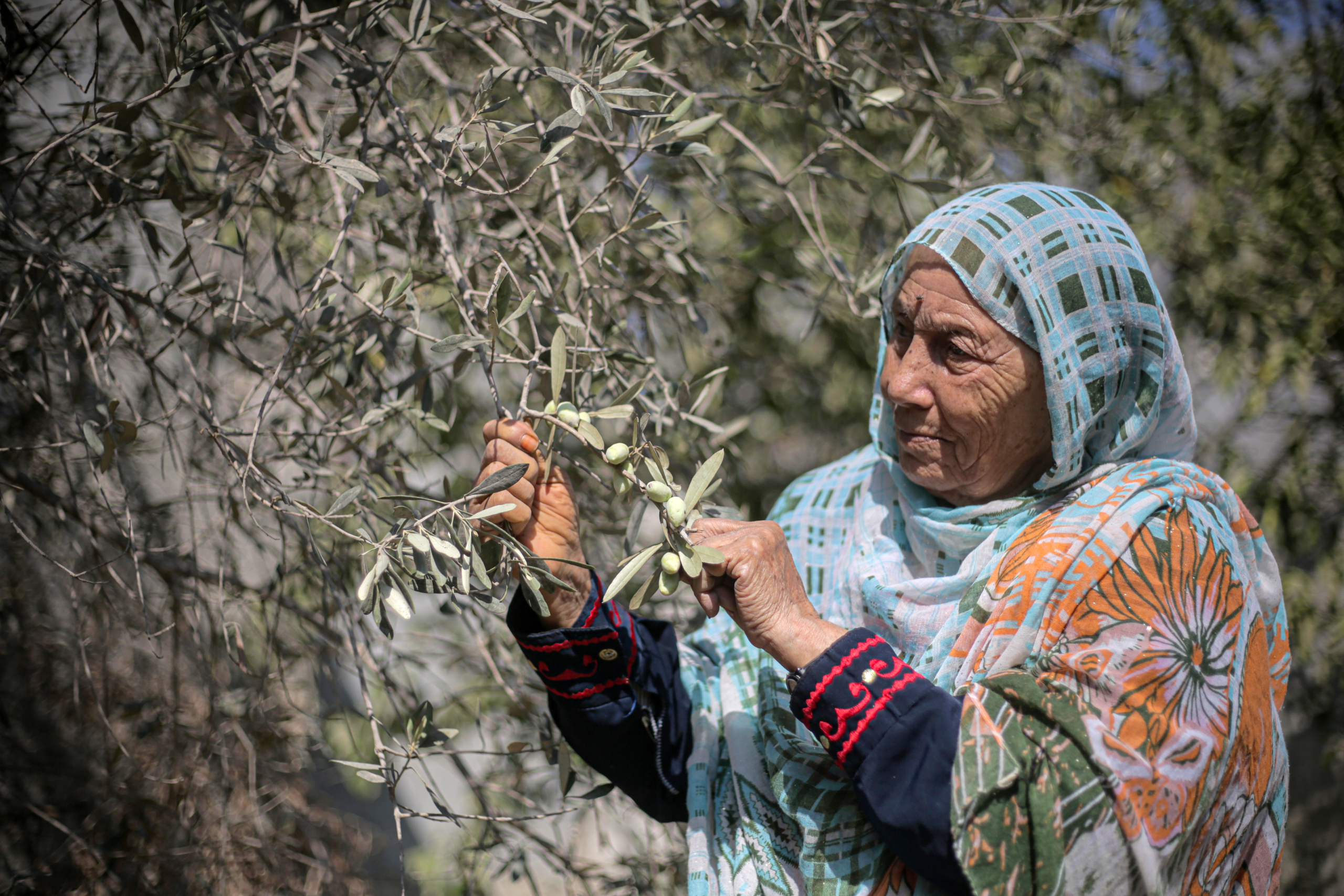
An elderly Palestinian woman gathers olives from a tree during the harvest season in Gaza. (Photo by Mohammed H. Salem / 2021)
But the harvest is not simply a few days of labor. For families, it is a season that returns every year, bringing back details they know well: the land they recognize, the trees they have grown accustomed to seeing, and the people who gather around them.
Family members may come together in the fields after months in which each has been busy with their separate lives. During their labor together, the roles between generations begin to overlap. The older generation knows the land, and the younger generation learns. One person knows which tree needs more time; another knows how to gather the fruit without harming the branches.
Knowledge is passed on in a mundane way, through watching, participating, and working together.
This family labor is not simply a way to complete the harvest faster. In Palestine, olives have long been tied to the economy, food, and social life. In its 2011–2012 report, The Food and Agriculture Organization of the United Nations describes the olive sector as economically and socially strategic, noting that it supported the livelihoods of at least 75,000 farmers and provided around 100,000 seasonal jobs in the West Bank and Gaza Strip.
But numbers alone cannot explain why people wait for this season. The images can. An entire family beneath the trees. A child carrying the fruit. A mother working beside her children. A man reaching into the crown of a tree. In these scenes, the olive season feels like an annual return to a place the family knows intimately.
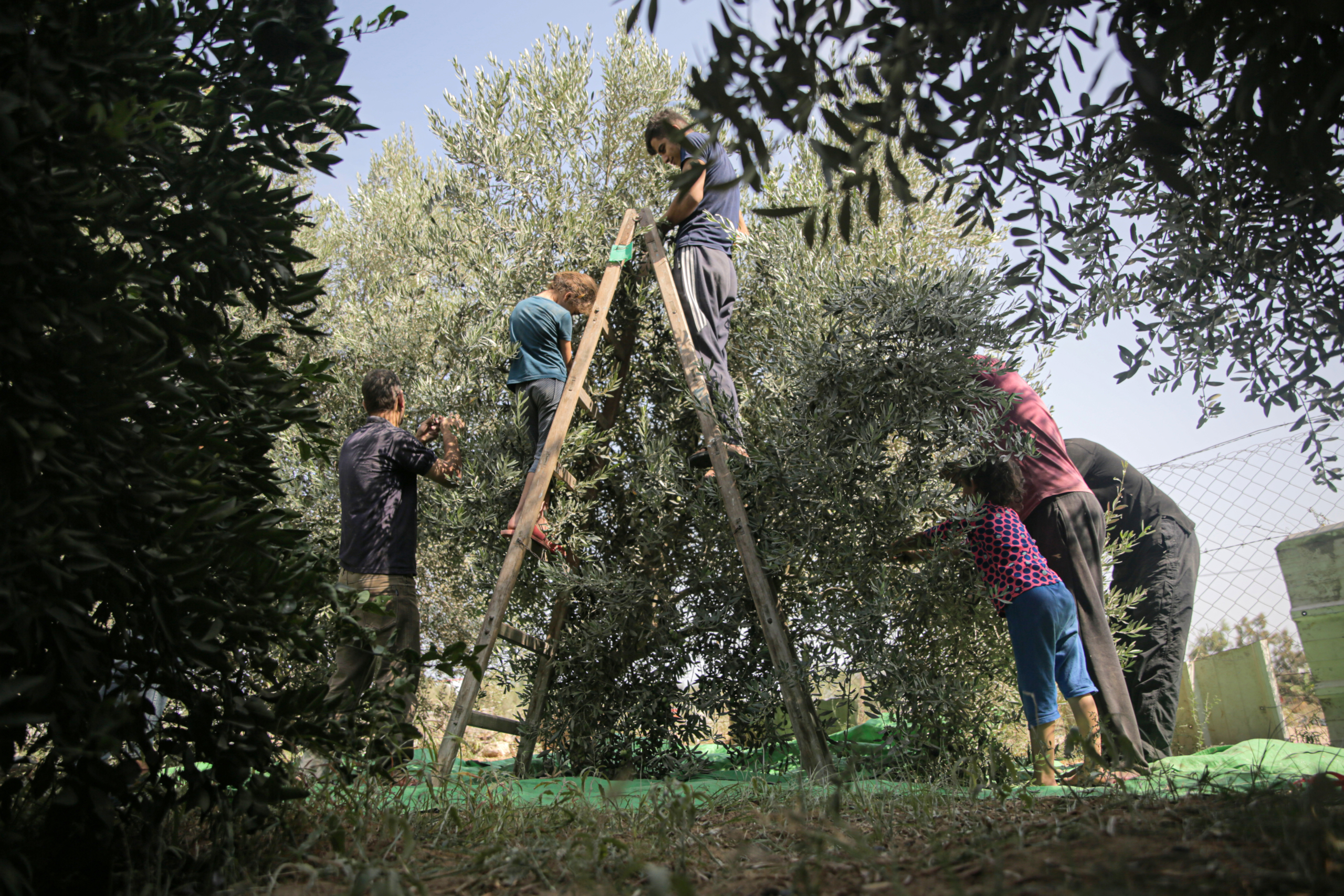
Members of a family work together to harvest olives, with different generations sharing the work among the trees in Gaza. (Photo by Mohammed H. Salem / 2021)
One Tree, More Than One Harvest
For many families, the relationship between people and olive trees does not end when the harvest is sold.
Olive oil is part of everyday food. It is stored in homes and used throughout the year. During the harvest season, people are not simply gathering a new crop; they are preparing for what comes after it.
The oil produced from these olives may remain in the home for months, appearing on the table with bread, in many Palestinian dishes, or becoming part of preserved olives.
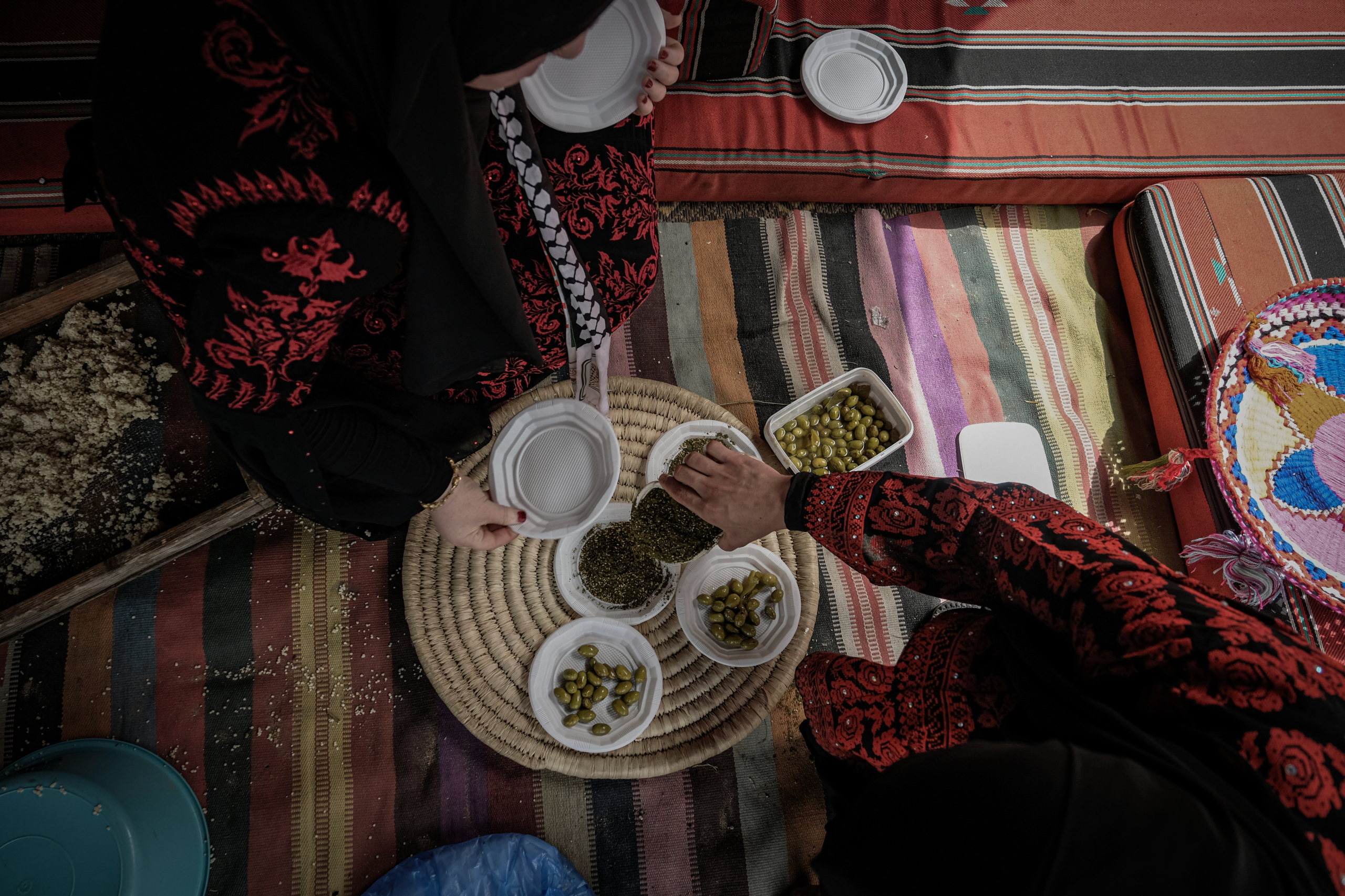
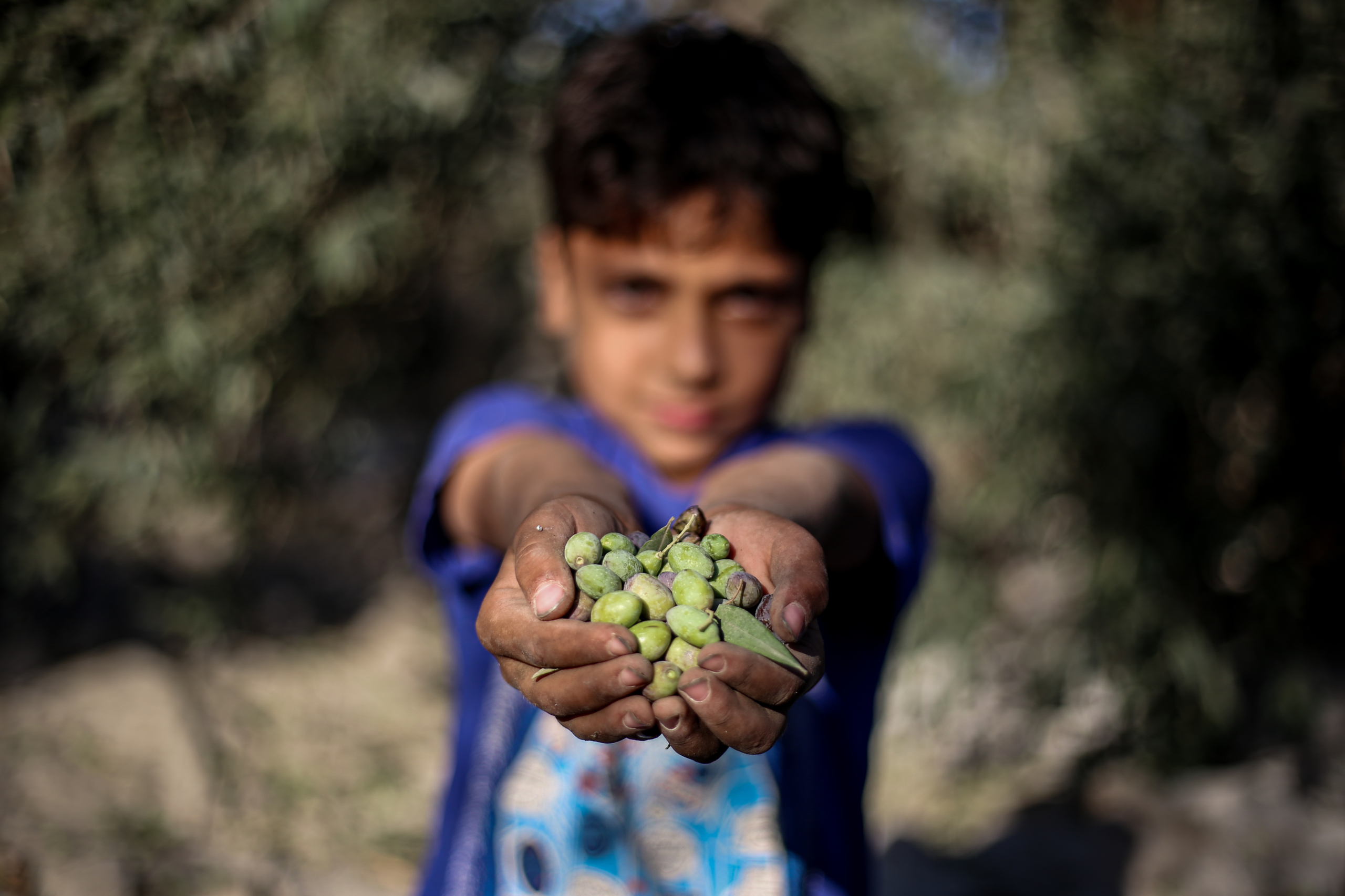
Freshly harvested olives are served alongside traditional Palestinian food during the olive harvest season. (Photo by Mohammed H. Salem / 2022)
There is another value that does not appear in bank accounts.
For many families, their relationship with olive trees did not begin with the present generation. There are trees their parents and grandparents knew before them, cared for, and harvested year after year. The faces around the tree change, but the tree remains.
Generations have stood beneath it—grandparents, parents, and then children and grandchildren. The younger generation may not know every detail of the lives of their ancestors, but they know the trees those generations left behind. In many families, the olive tree is something passed from one generation to the next—not simply as property, but as part of life itself.
Life Rooted in the Land Before the Nakba
Our olives today are not separate from the olives of our grandparents.
There are trees that were part of family life before the Nakba(*), when grandparents harvested their fruit and carried it home. Today, the fruit of those trees—or of trees through which that relationship has continued across generations—still finds its way to the tables of children and grandchildren. In that sense, what comes home at the end of the season is not simply oil. It is a piece of the family’s history.
(*) Nakba: The events surrounding the establishment of Israel on May 14, 1948, when approximately 750,000 Arab Palestinians were driven from their homelands. “Nakba” means “catastrophe” or “disaster” in Arabic. May 15 of every year is observed as “Nakba Day”.
With every new harvest, knowledge is passed on again. A child learns when the fruit should be picked, how it should be gathered, carried, and sorted. From the older generation come details that may seem small, but are the product of years of experience. This knowledge does not always need a book. It can pass through a word, a movement of the hand, or simply by watching someone older at work. One generation learned from the one before, just as parents learned from grandparents. And then the children carry that knowledge into the future. In this way, olive trees are a thread connecting generations of Palestinians. One generation plants and tends. Another harvests. Yet another eats from the same fruit years later.
In Gaza, where olive trees once represented a large share of the area planted with fruit trees, this relationship with agriculture was deeply visible in the structure of the agricultural sector itself. According to data from the Palestinian Central Bureau of Statistics, olive trees accounted for around 63 percent of the area planted with fruit trees in Gaza in 2021.
So when the fruit reaches the crates, what has been gathered is not merely a crop. It is part of a family’s economy, its food for the coming year, and an extension of an old relationship between the family and the land.
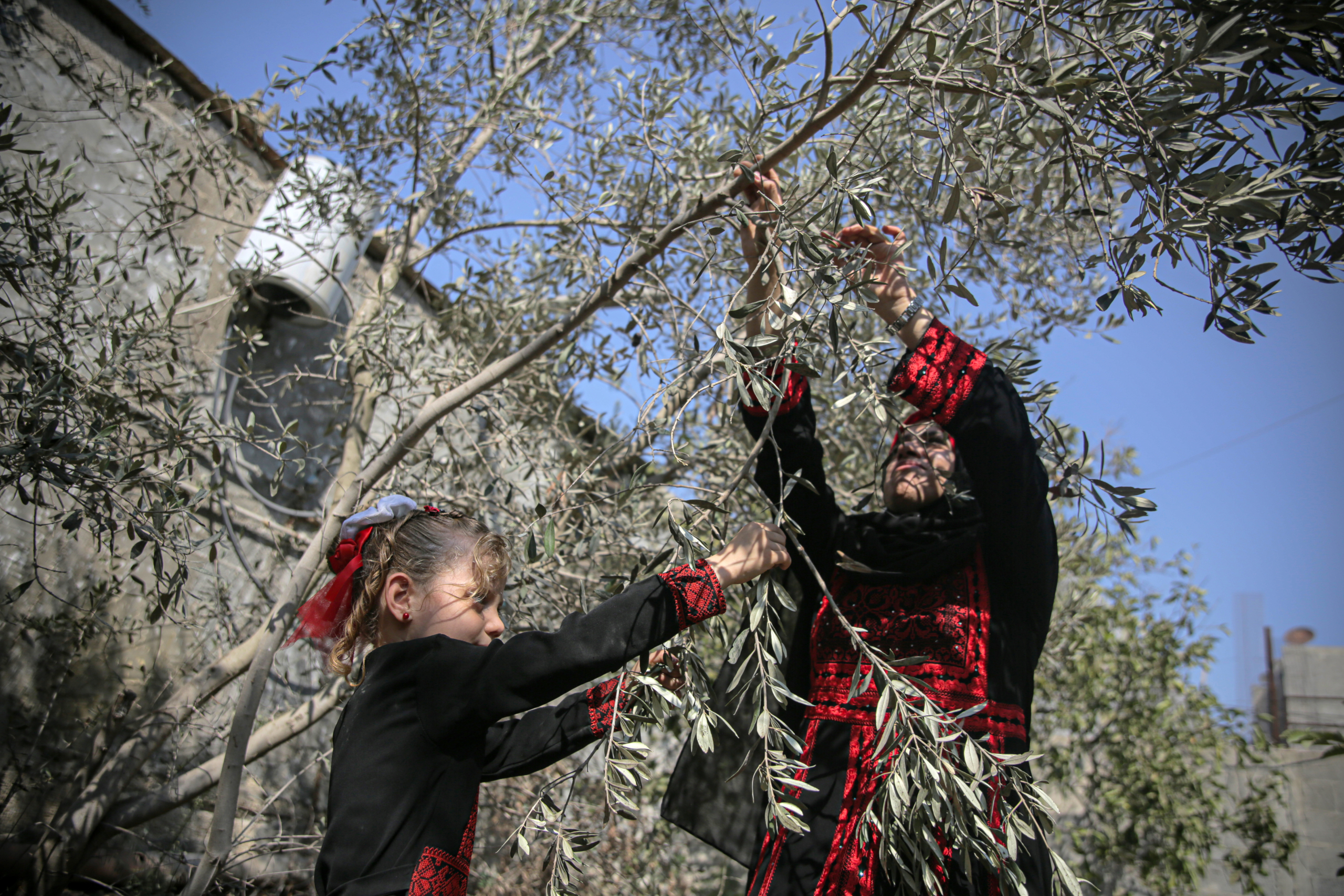
Family members gather olives from a tree, passing the work and knowledge of harvesting from one generation to the next. (Photo by Mohammed H. Salem / 2021)
The Land Has Taken on a Different Meaning
Today, it is impossible to speak about olives in Gaza without acknowledging that the relationship with the land itself has become more fragile. The war has caused extensive damage to the agricultural sector, and orchards of fruit trees, including olives, have been among the areas severely affected. The FAO continues to monitor damage to agricultural land and production chains.
But this story does not need to become a story only about destruction. The images before us say something else. They say that the land, despite everything, was cultivated. That there was a season. There were families laboring in the fields. There were children learning. And that there was oil emerging from the press. That, in itself, is part of the story that deserves to be told.
Because the continuation of the olive harvest does not mean that nothing has changed. It means that people are determined to hold on to something of their lives, their relationship with the land, and the traditions handed down to them by generations before.
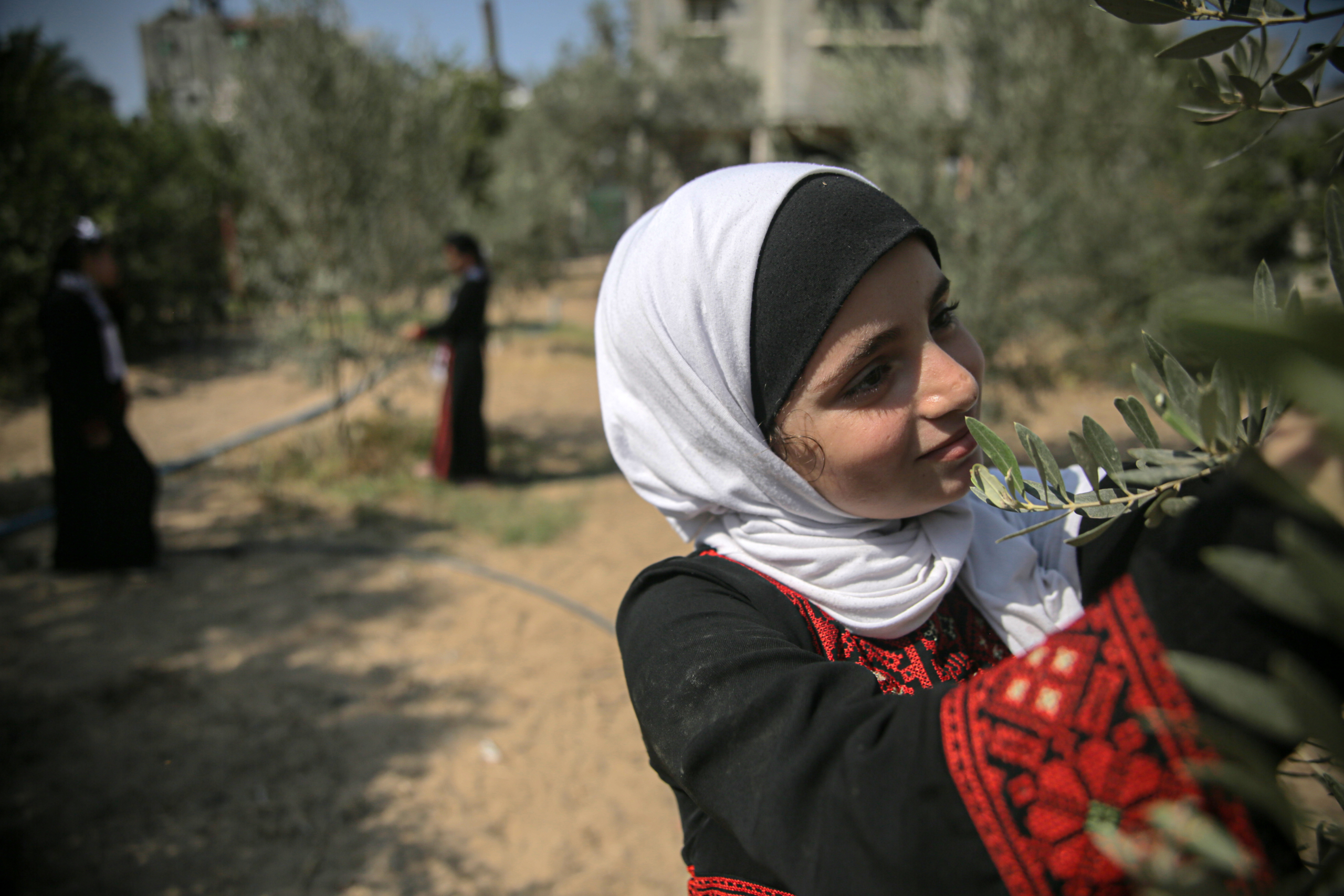
A Palestinian girl harvests olives while other family members work among the trees in the background. (Photo by Mohammed H. Salem / 2021)
In Part 2, we will follow the journey of how olives are pressed into oil and brought to the dining table. Through Mohammed’s photographs and words, we hope readers can feel the weight of these daily lives and traditions that have been devastated by the Israeli military invasion.
[Translator’s Note: On the Damage Caused by the Military Offensive Since October 2023]
The olive cultivation and vibrant way of life in Gaza described in this piece have faced devastating destruction following the large-scale military offensive launched by Israeli forces since October 2023. According to assessments by the Food and Agriculture Organization of the United Nations (FAO), the United Nations Satellite Centre (UNOSAT), and other agencies, agricultural land across the Gaza Strip has rapidly deteriorated, with orchards, olive groves, greenhouses, and critical agricultural infrastructure suffering extensive damage. Furthermore, analyses of satellite imagery indicate that the ongoing conflict has resulted in the destruction of the vast majority of Gaza’s permanent fruit tree crops.
Writerこの記事を書いたのは
Writer
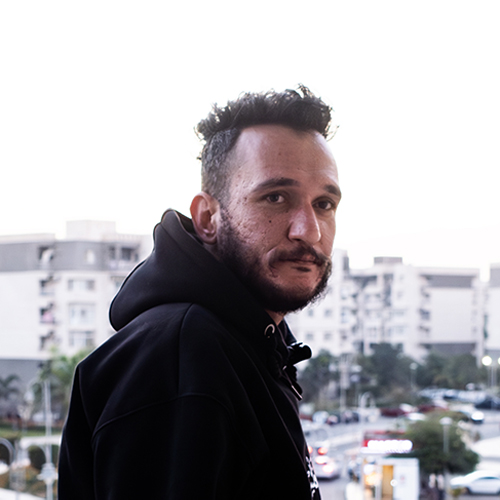
写真家モハンメド・H・サレムMohammed H Salem
パレスチナ・ガザ地区出身の写真家。様々な写真エージェンシーと協働するほか、プラットフォーム「Untold Palestine」の共同創設者の一人でもある。その作品は、国内外の多くの雑誌やメディアで発表されている。また、フリーランスとして「アルジャジーラ・イングリッシュ」とも提携している。
あわせて読みたい・聴きたい
本記事の取材・執筆や、本サイトに掲載している国内外の取材、記事や動画の発信などの活動は、みなさまからのご寄付に支えられています。
これからも、世界の「無関心」を「関心」に変えるために、Dialogue for Peopleの活動をご支援ください。
寄付で支えるメールマガジンに登録しませんか?
新着コンテンツやイベント情報、メルマガ限定の取材ルポなどをお届けしています。

 佐藤慧
佐藤慧 安田菜津紀
安田菜津紀 D4P取材班